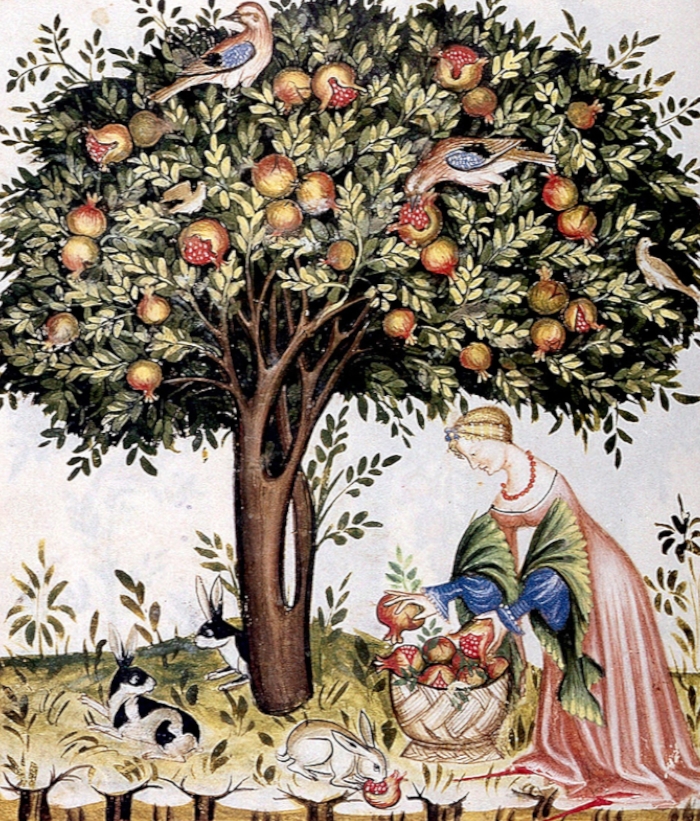
The pomegranate is an enduring and complex symbol. Across mythology, religion, medicine, and art, it carries a striking duality: it is a sign of life, fertility and divine abundance, and a darker emblem of death, entrapment and desire. This tension is intrinsic to the fruit itself. It’s hard, protective rind conceals a dense interior of blood-red seeds, visually and symbolically uniting opposites—outer restraint and inner vitality, sweetness and sharpness, life and mortality. Because of this, the pomegranate has become a powerful vessel for expressing both the positive and shadow dimensions of human experience.
The pomegranate has long symbolized fertility, prosperity and the generative force of life. In ancient Greek culture, it was sacred to Aphrodite and Hera, linking it directly to love, sexuality and the sanctity of marriage. Its many seeds made it a natural emblem of abundance, suggesting not only physical fertility but also the flourishing of relationships and communities. In the Jewish tradition, the pomegranate came to represent spiritual fullness and divine order, with the belief that it contains 613 seeds corresponding to the commandments of the Torah. In this context, the fruit symbolizes completeness and the presence of sacred law within the natural world.
Christian symbolism develops these life-affirming meanings while adding layers of sacrifice and renewal. The pomegranate’s deep red juice evokes the blood of Christ, while its clustered seeds symbolize unity within the Church. Renaissance artworks place the fruit in the hands of the Virgin Mary and the infant Jesus, where it becomes a quiet yet profound symbol of resurrection and eternal life. The fruit embodies the paradox of life emerging through sacrifice, reinforcing its role as a symbol of continuity and hope.
Almaas a transpersonal writer and spiritual teacher talks about passionate love being ‘pomegranate love’. He describes it as ‘fluid, like nectar, the presence is a dense liquid, sweet and tart and very pleasurable.’ It is a strong and powerful love. ‘When it is felt towards the Beloved the love itself unites you by erasing you.. as you approach the Beloved, the Beloved penetrates you as a light penetrating the whole soul.’ (Love Unveiled: Almaas 2020)
The pomegranate also carries a shadow dimension. This is expressed in the myth of Persephone and Hades. When Persephone consumes the seeds of the pomegranate in the underworld, she binds herself to it, condemned to spend part of each year among the dead. The fruit becomes a symbol of entrapment, transformation and the irreversible consequences of seemingly small actions. It marks a threshold between worlds—once crossed, it cannot be undone. The pomegranate embodies the darker aspects of existence: loss of innocence, the tension between freedom and constraint, and the inevitability of descent into unknown or unconscious realms.
The fruit’s blood-like juice has long been associated with mortality, sacrifice, and the fragility of the human body. At the same time, its sweetness introduces an element of temptation. The pomegranate can be seen as both nourishing and dangerous, suggesting that desire itself may carry hidden costs. This ambiguity raises enduring questions about agency and choice: is one drawn to the fruit freely, or subtly compelled? The answer remains unresolved, and it is precisely this uncertainty that gives the symbol its lasting power.
From a psychological perspective, particularly in the work of Carl Jung, the pomegranate can be understood as an archetype of the self and the unconscious. Its many seeds represent latent potential and inner multiplicity, while its enclosed structure suggests hidden depths waiting to be explored. Engaging with the symbol mirrors the process of confronting the unconscious—an experience that can lead to growth and integration but also requires facing discomfort and shadow aspects of the psyche.
Ultimately, the pomegranate endures as a symbol because it resists simplification. It does not merely represent life or death, purity or danger, but rather the intricate interplay between them. By holding together these opposing meanings, the pomegranate reflects a fundamental truth about human existence: that creation and destruction, joy and suffering, and light and shadow are inseparable. In this way, the fruit remains a potent and timeless symbol of the complexity of life itself.